
All Things Special Education
When Advocacy Isn't Enough: Understanding Special Education Due Process
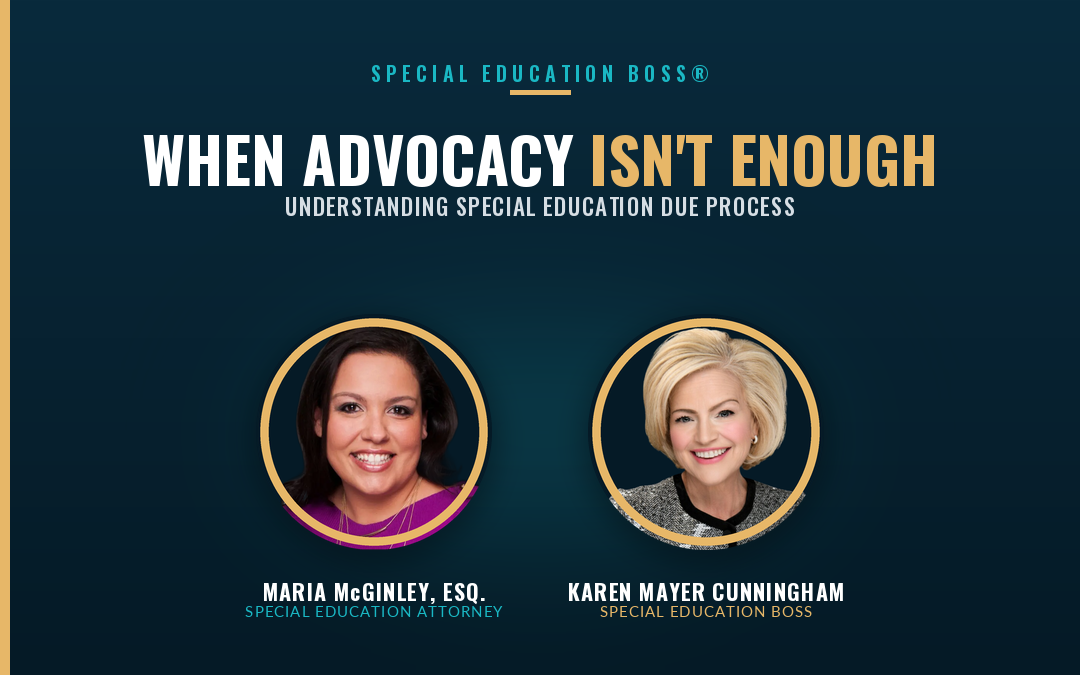
A candid conversation with special education attorney Maria McGinley, Esq., on the dispute process most families hope they never need, and how to be prepared if they do.
No parent sits down at the IEP table hoping for a fight. And no family ever says, "I cannot wait to go to due process." But sometimes advocacy alone does not get your child what they need, and you deserve to understand what comes next before you are standing in the middle of it.
In this episode of Special Education Boss®, Karen Mayer Cunningham sits down with special education attorney Maria McGinley for an honest, practical look at special education dispute resolution, including mediation, state complaints, and due process. Maria brings a perspective very few people have. She is a former special education teacher, a practicing special education attorney, and a parent who has sat at the IEP table for her own child.
Listen to the Podcast
Prefer to watch? The full conversation is on our YouTube channel. Watch the episode here.
Advocacy comes first. Due process is the last resort.
Before anyone talks about filing, the question is always the same: can this be solved through advocacy? Maria is clear that the goal is never litigation for its own sake. The eye should always be on resolving the disagreement first, through the IEP table, through resolution meetings, and through mediation, and only moving toward due process when the problem genuinely is not being solved.
Mediation, in particular, gives both sides real liberty. It is not binding, either party can walk away, and it often gives a family the chance to tell their story to someone new at the district level who actually wants to listen. Sometimes that is all it takes.
Due process is not about winning. It is about the child.
Many parents fear that filing means going to war with the school their child still attends every single day. But here is the reality both Karen and Maria return to: you go back to the same table, with the same teachers, in the same building. Due process is not about defeating your district. It is about getting your child what your child needs.
And your child keeps growing while a case runs. A year passes, needs change, new needs emerge. The conversation at the table has to keep going, no matter how a hearing turns out.
It is an administrative trial, and it takes a real toll.
This is not Law & Order. There is no dramatic courtroom moment. Due process is an administrative trial where your attorney calls witnesses and cross-examines the district's witnesses, and you sit through all of it. Maria is honest about the emotional and financial weight that carries. She has watched families come under enormous strain during the process, and she believes the most important thing an attorney can do is prepare a family early and keep that conversation going, so they always know what to expect next.
Your paper trail is your evidence. Your memory is not.
If there is one theme that runs through the entire conversation, it is this. The facts and the documentation are what an impartial hearing officer looks to. Persuasive arguments matter, but the evidence is what carries the day, and a paper trail is evidence in a way that memory never can be.
That is why Karen spends so much time in the present levels and the evaluations, the parts of the IEP many parents rush past on the way to the schedule of services. The obligation lives in those early sections. And when you have a concern, document it in writing and close in time to when it happened, because if it is not written down, it is far too easy for everyone to act as though it never happened.
Disagree in writing, and disagree professionally.
"Agree to disagree" has no place when your words are the record. If you disagree with what is in the IEP or in the district's deliberations, capture it. Maria's guidance, and Karen's practice for three decades, is the same: do not negotiate the wording line by line over email. Instead, respond with your own clear written account, your understanding of what happened at the meeting and your concerns, and let it become part of the record. The one exception is a grossly inaccurate fact that could affect how your child is served. That should be corrected.
As Maria puts it, you can disagree without being disagreeable. The professionalism protects your child and your credibility.
Endrew F. and what "meaningful progress" really means.
The Endrew F. decision raised the bar. A district can no longer point to barely-there, minimal progress and call it enough. Progress has to be meaningful, and meaningful in light of your child's unique circumstances. One practical way to test it: look at the IEPs year over year. Are the goals genuinely advancing, or are they the same goals simply reworded? A child who is significantly delayed can still be making real, meaningful progress, and a child above grade level can still be in an environment that does not meet their needs. It is always individualized.
Burden of proof: it matters which state you are in.
This is one of the most eye-opening parts of the conversation. In most states, the parent carries the burden to prove the district failed to offer a free appropriate public education. In a few, including New York and now Louisiana, the district has to prove that it offered FAPE. That single difference reshapes the whole process. When the burden sits on the family, the party with the fewest resources, who has already been aggrieved, has to come forward and build the case. When it sits on the district, the question becomes whether they can actually explain how their IEP fits this particular child.
Evaluations, recordings, and knowing when to call a lawyer.
The conversation closes with the questions families ask most. On Independent Educational Evaluations, Maria and Karen both caution against requesting an evaluation type your state does not actually use or credential, and Karen recommends starting with the district's own evaluators. On recording IEP meetings, the rules vary by state, and the bigger question is your objective: are you recording to catch someone, or simply to remember what was said? And on the hardest question of all, when to move from advocacy to an attorney, Maria's answer is striking: it is often the advocate who tells the family it is time. Advocates serve a vital role, and the best ones know exactly where their line is.
One tool to take with you: the TED framework
When the school says your child is "making progress" or "doing fine," do not let it sit there. Gather information with three openers: Tell me what that looks like. Explain what you mean by that. Describe it for me. Open questions gather data. Data is what changes outcomes.
Meet the guest
Maria McGinley, Esq. is a special education attorney serving families in New York and the surrounding area. A former special education teacher and a parent who has navigated the IEP process herself, she represents families at every stage, from the IEP table through due process and appeals. Learn more about her work at mlgsped.com.
This episode is educational training, not legal advice, and does not create an attorney-client relationship. Laws and procedures vary by state. For guidance on your specific situation, consult a qualified professional in your jurisdiction.
You do not have to figure this out alone.
Special Education Academy™ helps parents, advocates, and professionals understand the process and sit at the table prepared. Have a question for our team? We would love to hear it.
advocate@specialeducationacademy.com
Explore the Academy at specialeducationacademy.com
"When we get it right for the child, we get it right for everyone."
— Karen Mayer Cunningham, Special Education Boss®