
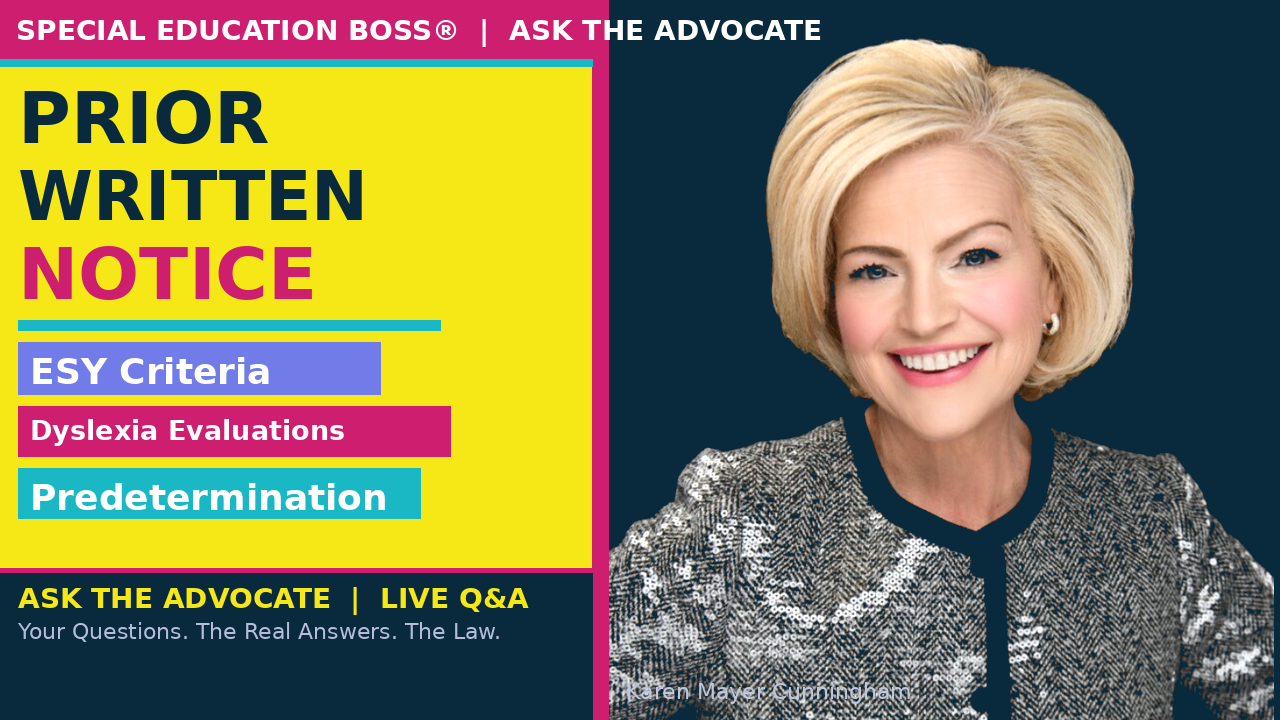
Prior Written Notice, ESY & Dyslexia Evaluations — Your Questions Answered
Karen Mayer Cunningham answers your live questions — and none of the answers are soft. This is the last full week of IEP meetings and the truth is coming out.
|
Special Education Boss®
|
14 min read
Watch the full episode above or listen on the Special Education Boss® podcast.
It is the last full week of IEP meetings. Karen Mayer Cunningham is answering your live questions — and she is not pulling punches. If the IEP was left vague on purpose, if the district violated a mediated agreement, if you have been told no without a reason — this episode is for you.
Every week inside the Special Education Academy, Karen goes live to answer the questions that parents, advocates, and educators are actually facing — not the easy ones, but the ones that keep you up at night. This session covered some of the most critical topics in special education law, from prior written notice to ESY criteria to why you should stop asking for a dyslexia evaluation.
Here is a breakdown of every major topic covered — with the law behind each answer.
What Is a Prior Written Notice — and What Must It Include?
Prior written notice is one of the most important documents in special education — and one of the least understood. Karen compares it to Sasquatch: you have heard about it, but people rarely see it done correctly.
A prior written notice is a legal obligation for every school district receiving federal funds under IDEA. It must be provided whenever the district proposes or refuses to take any action related to a student’s identification, evaluation, educational placement, or the provision of FAPE. It has seven legally required components. Writing N/A on any of those fields is not an option — they are all applicable, every single time.
“A lot of schools say this IEP and these deliberations constitute a prior written notice. They don’t. They constitute an IEP and deliberations, Barbara. You are not a constitutor. You are required to provide a legally complete prior written notice.”
What to do if you receive an incomplete PWN: Do not tell the district it is wrong. Ask instead — “This document is insufficient. Is this the final prior written notice you are providing us?” That question creates a record without tipping your hand.
Stop Asking for a Dyslexia Evaluation — Ask for This Instead
This is one of the most common mistakes parents make — and it costs their children significant services. When you ask for a dyslexia evaluation, you get a dyslexia evaluation. That is it. But there are four specific learning disabilities in reading, and a child can have any combination of them.
- Dyslexia — phonemic awareness and decoding
- Basic reading — the ability to take a word apart and put it back together fluently and automatically
- Reading fluency — the rate and expression with which you read
- Reading comprehension — understanding what has been read
Request a full cognitive evaluation in all seven areas of cognitive processing. Then request formal achievement testing in reading, writing, and math — and add oral expression and listening comprehension. This comprehensive approach allows the evaluator to identify all nine possible specific learning disabilities, not just one. You don’t know what you don’t know — but now you do.
ESY Criteria: You Don’t Get It — You Require It
Extended School Year services are not something a district hands out. They are something a student requires — based on documented evidence. And the two-prong test is specific.
The student shows documented regression on IEP goals when services are interrupted — and it takes a significant amount of time to recoup that lost skill when services resume.
There is a documented concern that the student will lose critical skills — skills that are foundational to their educational progress — if services are interrupted during the summer break.
If two students in a class received ESY and your child did not, that is not necessarily a violation — ESY is individualized. But if you believe the determination was wrong, go back to the IEP table and say: “I believe we may have missed something in our last meeting. I would like to address ESY again.”
When a School District Violates a Mediated Agreement
Settlements, mediated agreements, and state complaint resolutions are legal requirements — not suggestions. A school district that was not compliant before you mediated will not become compliant simply because an agreement was signed.
“Before you mediate with these people — if they were dirty when you got here, they’re gonna be dirty after you leave. If you don’t require them to comply, they’re not going to self-report. The school district will not go to the state and say we didn’t do it. You have to say something.”
What to do when a district violates a settlement:
- Contact the state education agency and report non-compliance
- Reach back out to the fact finder, hearing officer, or the dispute resolution entity
- Document every instance of non-compliance with dates and details
- Go public if necessary — school board members and leadership respond to accountability
- Consult with a trained advocate — this is exactly what they are trained for
The IEP Was Left Vague on Purpose — Is That Legal?
“What are you talking about? It is a legal document that you take federal grant money for. It is required to be unbelievably specific.”
An IEP is not a living document left open to interpretation. It is a legal contract that specifies exactly what services a student will receive, how often, for how long, in what setting, and by whom. A school that tells a parent the IEP was intentionally left vague has no legal standing for that position. Document it. Put it in the record. And get an advocate involved.
More Questions. The Real Answers.
Can a school district delay an evaluation until next year?
No. When you request an evaluation, the district has 15 days to respond — either granting or denying the request. They may not be required to conduct testing during school breaks, but they cannot legally defer your request to the following school year. If a district tells you they are not doing evaluations in May, document that communication and reach out to your state education agency.
Who is responsible for writing modifications?
Modifications are a special education product — not a general education product. A general education teacher and a paraprofessional are not the appropriate parties to design or deliver modifications. That is the legal responsibility of a certified special educator. If your child’s modifications are being written by a general ed teacher or implemented by a para without special education oversight, that is a compliance issue worth documenting.
What is predetermination — and how do you put it on the record?
State it clearly in the meeting: “The LEA’s decisions appear to be predetermined. You have denied the parent meaningful participation in the IEP process. You have also denied them IEP team membership. You have denied the student a FAPE and you have harmed him.” Then ask for it to be captured in the deliberations. If you do not say it, it never happened.
Can a school skip IEP implementation for virtual school students?
Karen’s position is clear: virtual school is not an appropriate setting for most students with disabilities. There is no legal mechanism to modify a Zoom session or provide physical accommodations in a student’s living room. If your child with a disability is in a virtual school setting, understand that IEP implementation obligations may not be fully achievable — and that virtual school may not be the best placement for your child’s needs.
Should I ask for a 504 plan or an IEP evaluation?
Always ask for an IEP evaluation. An IEP evaluation will either identify a need for special education services (and open the door for an IEP) or eliminate that possibility — in which case a 504 may be appropriate. Starting with a 504 request can shortcut the evaluation process and leave significant services on the table. Karen says it plainly: 504 plans are good for putting under coasters. Start with the full evaluation.
The Epic Educator Academy — Launching June 1st
A dedicated training space for school district employees — teachers, paraprofessionals, case managers, diagnosticians, administrators, and school staff. Live training every Monday at 7PM Central. $27/month. Co-led by Karen Mayer Cunningham and Chana Dixon, a special education supervisor with 23 years in the field.
Frequently Asked Questions
Special Education Boss® Podcast
Find this episode and every Ask the Advocate session on the Special Education Boss® podcast — available on all major platforms.
Resources from This Episode
- Special Education Academy (live Monday nights 8PM): specialeducationacademy.com
- Epic Educator Academy (June 1 — for school district employees): specialeducationacademy.com/training
- Epic IEP Book Bundle: theepiciep.com — The Epic IEP, The Epic IEP Law Book, and The Epic IEP Para
- Two-Day Advocacy Intensive — Lexington, Kentucky, May 30–31
- Mastermind — starts June 4th (Two-Day Intensive is a prerequisite)
- Hire a trained advocate: advocate@specialeducationacademy.com
Karen Mayer Cunningham
Karen Mayer Cunningham is a nationally recognized special education advocate, trainer, and bestselling author of the Epic IEP book series. She trains everyone who sits at the 504 and IEP table — parents, teachers, paraprofessionals, administrators, and attorneys — to navigate and negotiate successful student outcomes using federal law. Her mission: get it right for the child, get it right for everybody.
Join the Special Education Academy
Every Monday at 8PM, Karen goes live to answer your questions, cover the law, and give you exactly what you need to walk into your next IEP meeting prepared.